
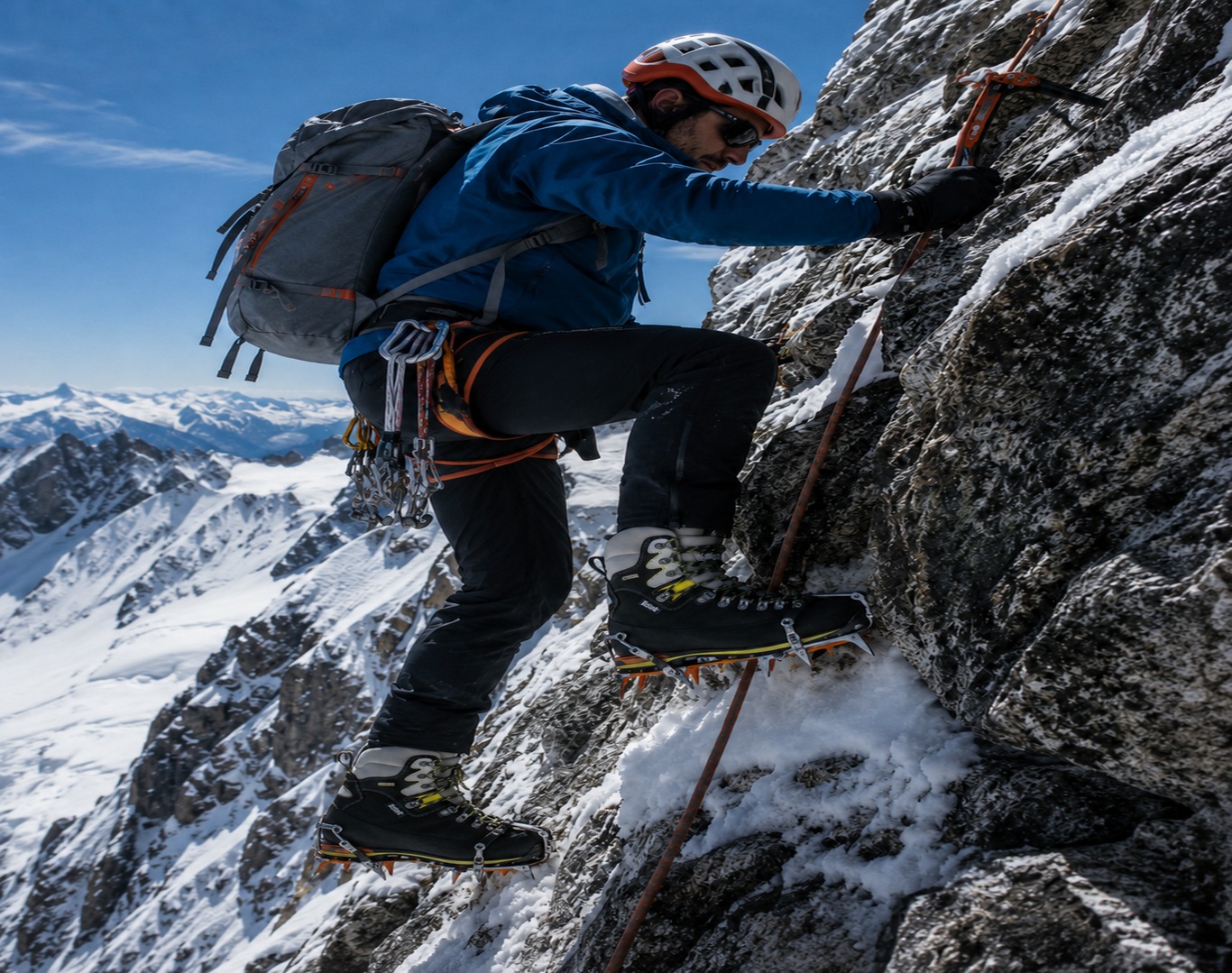
What features should technical mountaineering boots have for alpine climbing?
All high-altitude mountaineering boots are suitable for technical alpine climbing.
For this type of activity, footwear must provide rigidity, precision, insulation, protection and secure integration with crampons, as it is used on hard snow, ice, rock, couloirs, ridges and mixed terrain.
- They must have a sufficiently rigid sole for precise footholds.
- They must be compatible with crampons, especially automatic or semi-automatic models.
- They must protect against cold, moisture, impacts and abrasion.
- They must provide a precise fit that prevents the foot from moving inside the boot.
- They must feature a technical outsole, such as one made by Vibram, to improve traction and durability.
- They must belong to a dedicated high-mountain range, rather than an advanced trekking range.
Direct answer
High-altitude mountaineering boots for technical climbing must be rigid, crampon-compatible, waterproof, insulated and durable. Unlike trekking boots, they are designed for safe movement on steep snow, ice, rock and demanding alpine terrain.
- High rigidity for climbing with crampons.
- Compatibility with automatic or semi-automatic crampons.
- Waterproof and breathable membrane.
- Thermal insulation for cold and snowy conditions.
- Vibram outsole with good grip on technical terrain.
- Rubber reinforcements at the toe, heel and sides.
- Stable cuff to protect the ankle.
- Precise lacing system that allows the instep and cuff to be adjusted separately.
Practical context: where technical high-altitude mountaineering boots are used
In this context, high-altitude mountaineering boots are not intended for easy trails or low-difficulty routes. Their purpose becomes clear when the terrain demands stability, protection and precision, especially in activities where a misplaced step can have serious consequences.
- Ice climbing.
- Snow couloirs.
- Alpine ridges.
- High-mountain traverses involving snow or glaciers.
- High-altitude expeditions in cold conditions.
- Mixed rock, ice and snow terrain.
- Winter ascents.
- Technical approaches with crampons either carried in the pack or already fitted.
Rigidity: the foundation of a technical boot
Above all, rigidity is one of the features that most clearly distinguishes high-altitude mountaineering footwear from trekking footwear. A rigid boot allows crampons to bite more effectively, provides precise support on small edges and maintains stability on slopes where a flexible sole would lose precision.
- Facilitates the use of automatic crampons on ice and hard snow.
- Improves front-point support on steep slopes.
- Reduces foot fatigue on technical footholds.
- Provides security in mixed climbing.
- Prevents excessive twisting of the sole.
- Helps maintain balance on ridges and exposed traverses.
Crampon compatibility
Secondly, high-altitude mountaineering boots for technical climbing must accept crampons suited to the activity. In Bestard’s High Mountain range, the brand states that its models are compatible with automatic crampons, an important requirement for technical routes over snow, ice and rock.
- For technical alpine climbing, automatic or semi-automatic crampons are recommended.
- The boot sole must have attachment points at the toe and heel.
- The connection between the crampon and the boot must be secure and free from play.
- The rigidity of the sole must be appropriate for the binding system.
- Soft boots should not be used with technical crampons.
- Before a route, the actual compatibility between the boot and crampon must always be checked.
Vibram outsole: grip, durability and precision
It is worth noting that Vibram outsoles are an important feature in many technical mountain boots because of their durability, traction and performance on uneven terrain. In high-altitude mountaineering boots, the outsole must not only grip rock and approach terrain, but also work effectively with crampons and withstand constant abrasion.
- Improves traction on rock, compacted snow and mixed terrain.
- Provides resistance to abrasion.
- Helps maintain stability on lateral footholds.
- Improves the durability of the footwear.
- Can be combined with technical midsoles to balance rigidity and comfort.
- Models such as the Bestard Fitz Roy feature a Vibram outsole with an EVA midsole, designed to combine grip, low weight and comfort.
Waterproofing, breathability and insulation
In addition, high-altitude mountaineering footwear must protect the foot from water, snow and cold without causing excessive moisture to build up inside. During technical activities, the foot may alternate between intense exertion and cold stops, making thermal management essential.
- The waterproof membrane prevents melted snow and moisture from entering.
- Breathability helps release perspiration during exertion.
- Thermal insulation provides protection in cold, windy and icy conditions.
- The lining must remain comfortable during long days.
- Protection from moisture reduces the risk of blisters and chilling.
- Bestard states that its High Mountain boots with GORE-TEX Insulated Comfort are waterproof, breathable and insulated.
External protection and durability
Technical climbing also requires the boot to withstand impacts, friction and continuous contact with rock, ice and crampons. High-altitude mountaineering boots therefore need a more robust construction than conventional trekking boots.
- Full rubber rand.
- Reinforced toe for impact protection.
- Protected heel for descents and crampon use.
- Abrasion-resistant outer material.
- Reduced or protected seams in critical areas.
- Cuff designed for snow, rock and uneven terrain.
- Adjustable tongue for improved protection and comfort.
Fit and last precision
Likewise, fit is crucial in high-altitude mountaineering boots for technical climbing. The foot must be held securely without being compressed, because a boot that is too roomy allows internal movement, while a boot that is too narrow can cause pain, cold feet or loss of sensation.
- The heel must remain stable without lifting while walking.
- The toes must not hit the toe box on descents.
- There must be enough room for technical socks and to prevent toe compression.
- The instep must allow precise adjustment.
- The cuff must provide support without completely restricting freedom of movement.
- They should be tried on with the socks that will be worn in the mountains.
- The fit should also be checked on a ramp or inclined surface.
Weight and comfort on approaches
However, a technical boot should not be assessed solely on its rigidity. Many high-mountain traverses and high-altitude expeditions involve long approaches, changes in terrain and many hours of activity, so the balance between protection and comfort also matters.
- A boot that is too heavy increases fatigue.
- A boot that is too light may compromise insulation or protection.
- The cuff should allow walking without excessive discomfort.
- The midsole should absorb impacts during approaches.
- The footbed should provide stability and comfort.
- The lacing system should allow different adjustments for walking and climbing.
Bestard high-mountain models and range
In Bestard’s range, the High Mountain family includes models designed for mountaineering and high-altitude activities. On Bestard’s official website, models such as the Top Extreme Lite, Elbrus, Fitz Roy, Mont Blanc FF, Climbing Guide FF and Climbing Guide Lady FF appear in this category.
- Bestard Fitz Roy: a technical high-altitude mountaineering boot compatible with all types of crampons and featuring a GORE-TEX Insulated Comfort lining, according to the brand’s product information.
- Bestard Top Extreme Lite: a double boot from the High Mountain family, designed for demanding high-altitude conditions and expeditions in extreme cold.
- Bestard Mont Blanc FF: an option within the High Mountain range for technical alpine activities.
- Bestard Climbing Guide FF: a model designed for technical mountain use.
- Bestard Climbing Guide Lady FF: a version in the same family adapted to a women’s last.
- Bestard Elbrus: an alternative within the High Mountain range for demanding mountain activities.
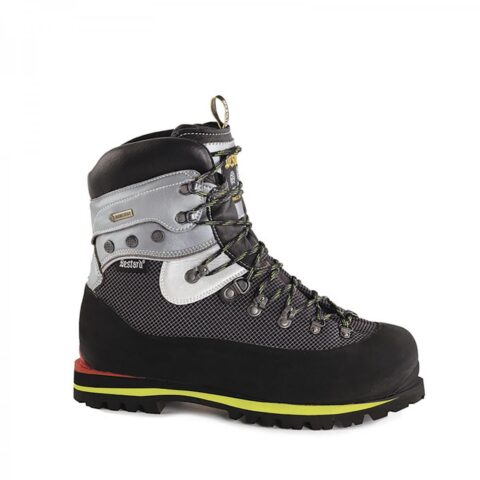
High-altitude mountaineering boot – Bestard – Top Extreme Lite
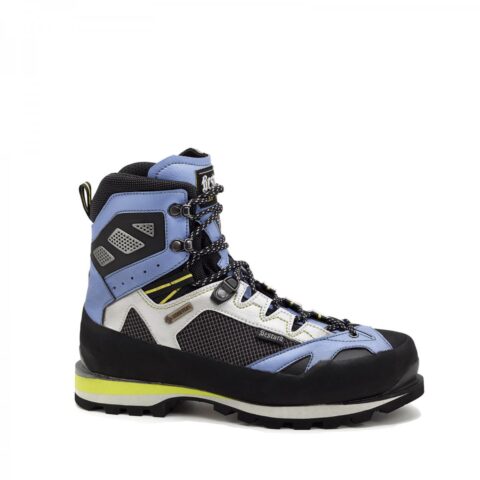
High-altitude mountaineering boot – Bestard – Laady – FF
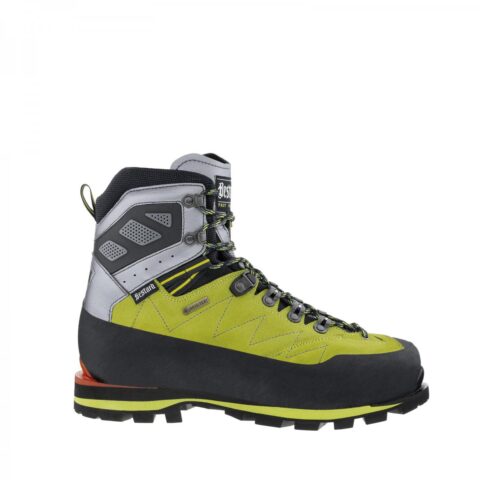
High-altitude mountaineering boot – Bestard – Mont Blanc FF
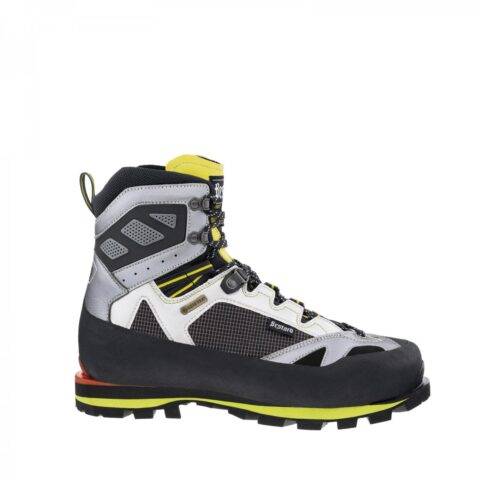
High-altitude mountaineering boot – Bestard – Climbing Guide FF
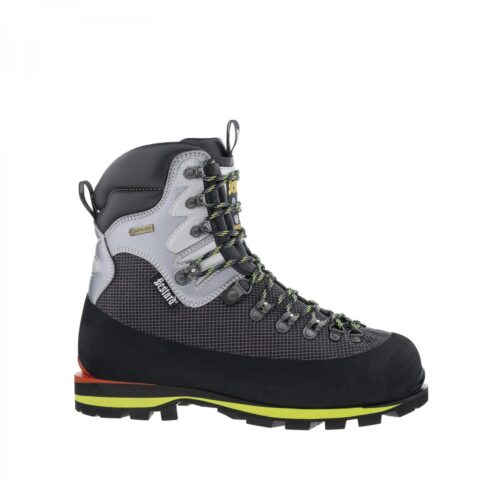
High-altitude mountaineering boot – Bestard – Fitz Roy
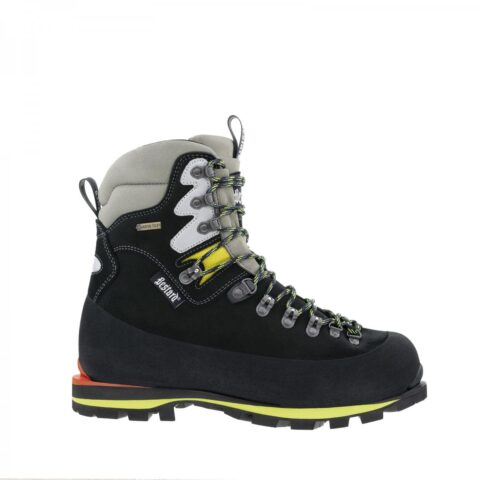
High-altitude mountaineering boot – Bestard – Elbrus
Why choose dedicated high-altitude mountaineering boots for technical alpine climbing
Consequently, choosing dedicated high-altitude mountaineering boots makes sense when the activity goes beyond advanced trekking and enters technical alpine terrain. In these situations, the footwear must cope with crampons, ice, hard snow, rock, vertical ice faces and low temperatures, rather than merely uneven paths.
- They provide greater rigidity than trekking boots.
- They improve safety when using crampons.
- They provide better protection against cold and moisture.
- They withstand impacts and abrasion more effectively.
- They offer greater precision on technical footholds.
- They are better suited to high-mountain traverses involving snow or glaciers.
- They are more appropriate for high-altitude expeditions where footwear is pushed to its limits.
- They combine protection, insulation and stability in a single system.
Which high-mountain accessories should be carried with the footwear
In this respect, high-mountain accessories also affect footwear performance. A good technical boot can lose effectiveness when paired with unsuitable socks, poorly adjusted crampons or gaiters that do not provide enough protection in deep snow.
- Crampons compatible with the boot.
- Thermal and breathable socks.
- Gaiters for snow, ice or mud.
- Suitable insoles, if required.
- Spare laces.
- A crampon cover or bag for transport.
- Care product for leather or technical materials.
- An appropriate drying system after the activity.
Common mistakes when choosing high-altitude mountaineering boots
However, many poor choices are made when a robust trekking boot is confused with a technical high-altitude mountaineering boot. They may look similar, but their performance on hard snow, ice or when used with crampons is very different.
- Choosing boots that are too flexible for crampons.
- Prioritising only initial comfort.
- Using trekking boots for technical climbing.
- Failing to check crampon compatibility.
- Buying a size without trying the boots on with technical socks.
- Ignoring the insulation required for cold conditions.
- Failing to assess the outsole and rigidity.
- Wearing new boots for the first time during a demanding activity.
FAQ about high-altitude mountaineering boots for technical climbing
Below are answers to the most common questions about high-altitude mountaineering boots, technical footwear and their use in alpine climbing. These answers are intended to resolve practical questions before choosing a boot for snow, ice or mixed terrain.
What is the difference between high-altitude mountaineering boots and trekking boots?
The main differences lie in rigidity, protection and crampon compatibility. Trekking boots are designed for walking on non-technical mid-mountain routes, whereas high-altitude mountaineering boots are designed for snow, ice, cold, rock and alpine progression.
- High-altitude mountaineering boots are rigid.
- They accept technical crampons.
- They provide better protection against the cold.
- They have more extensive external reinforcements.
- They usually feature advanced insulation and waterproofing.
- They weigh more than many trekking boots.
- They are less flexible but safer on technical terrain.
Which high-altitude mountaineering boots are suitable for technical alpine climbing?
Rigid high-altitude mountaineering boots that are compatible with automatic crampons and provide good thermal protection are suitable. At Bestard, the High Mountain family includes models designed for this type of alpine use.
- Boots with a rigid sole.
- Boots with crampon attachment points.
- Boots with a waterproof membrane.
- Boots with thermal insulation.
- Boots with a technical Vibram outsole.
- Models such as the Fitz Roy, Mont Blanc FF or Climbing Guide FF within the High Mountain range.
Are rigid boots necessary for using crampons?
Yes. Rigidity is necessary for technical climbing and automatic crampons. A flexible boot can cause unwanted movement, loss of precision, poorer transfer of force to the crampon and even crampon detachment.
- Rigidity improves stability.
- The crampon works more precisely.
- Front-point support is safer.
- Twisting of the sole is reduced.
- Foot placement is more effective on ice and hard snow.
- On technical terrain, excessive flexibility can be a problem.
How should high-altitude mountaineering boots fit?
High-altitude mountaineering boots should fit firmly around the heel and instep, with enough room in the toe box to prevent impact and allow the use of technical socks. The fit should feel secure but not painful.
- The heel should not lift.
- The toes should not touch the toe box on descents.
- The instep should be held securely.
- The cuff should stabilise the ankle.
- The size should be tested with technical mountain socks.
- It is advisable to walk on both flat and sloping surfaces before deciding.
- They should not be worn for the first time on an expedition or a long technical route.
Which high-mountain accessories should be carried with the footwear?
The most important high-mountain accessories are automatic crampons, technical socks, gaiters and maintenance products for conditioning and waterproofing leather. These accessories help the boot perform correctly in snow, ice and cold conditions.
- Crampons adjusted to the boot.
- Thermal mountain socks.
- Waterproof gaiters.
- Spare laces.
- Technical insoles.
- Care product for leather or outer materials.
- Crampon bag for safe transport.
In summary…
High-altitude mountaineering boots for technical climbing should be chosen for their rigidity, compatibility with automatic crampons, waterproofing, insulation, protection and precision. A Vibram outsole, external reinforcements and a well-suited last are essential for moving safely over snow, ice, rock and mixed terrain.
- For trekking, a less rigid boot is usually sufficient.
- For technical climbing, rigidity and crampons are essential.
- For high-mountain traverses, the balance between comfort and protection matters.
- For high-altitude expeditions, insulation and durability become more important.
- At Bestard, the High Mountain range includes dedicated models for this type of activity.